

Racer Robo
Description
Race through ramps, dodge obstacles, and master the course in our adrenaline-pumping Robo Race! Ready, set, go!
The Racer Robo competition on Mekathlon is a thrilling robotics event that challenges participants to design, build, and race their own robots. The objective is to create a robot that can navigate a challenging race track, showcasing innovation, creativity, and technical skills. Participants register and submit their robot designs, which are then built and tested for performance and reliability. The robot race competition features a tournament-style format, with winners advancing to the next round, and the fastest robot crowned the ultimate winner.
This competition emphasizes innovation, creativity, and technical skills, while fostering teamwork, critical thinking, and time management. Participants develop valuable skills in robotics, coding, and engineering, and learn from others in a competitive and exciting atmosphere. The Racer Robo competition is ideal for students, professionals, and enthusiasts passionate about robotics, coding, and engineering. By participating, individuals can demonstrate their talents, win recognition, and take their skills to the next level. Mekathlon's Racer Robo competition is a unique opportunity to showcase innovation and speed, making it a must-join event for robotics enthusiasts worldwide.
Eligibility Criteria
Participants from the given category can participate in the Racer ROBO competition:
- Developers - The participants will be students of Grades 3 to 7
- Innovators - The participants will be students of Grade 8 to 12
In the Developers category, only 50 Teams are eligible to participate, encompassing both national and international countries.
In the Innovators category, only 50 teams are eligible to participate in the semi-final round from each city.
Team size: Minimum 1 and Maximum 5
How to Participate in the Racer Robo Competition?
In the Racer Robo competition, three teams will compete to race against time, with each team consisting of 1 Wireless Bot.
- Register yourself and your team members as a user on the official Mekathlon website.
- Once your team members are registered, you may select the Racer Robo competition from the competition list in your login panel, and apply. You will also be needed to select members from your team who will participate in the competition. A minimum of 1 and a maximum of 5 members in 1 team can participate. Also, select your city for participating in the event
- Construct a wireless autonomous Bot. Ready-made bots will not be allowed to compete. Only self-made bots will be allowed to participate.Lego bots are allowed.
Bot Specifications
- Each team can present only one Racer Bot for the competition.
- Bots can not be autonomous and should involve wireless communication between an operator and the bot.
- Bots can be circular, square, or of any shape, but must fit inside a rectangular box of 30cm long, 30cm wide, and 40 cm in height at any given point in time.
- The maximum weight of the bot can not exceed 5kg at any given point in time.
- Robots must be constructed and programmed in a way that their movement is not limited to only one direction and must move in all directions.
- The electric voltage anywhere inside the machine cannot exceed 16.8V at any given point in time.
- Batteries must be sealed, immobilized electrolyte type (gel cell, lithium, NiCad, or dry cells)
- Infrared light-reflecting materials must not be used on the outside. Minor parts that reflect infrared light could be used only if other robots are not affected. Robots must not produce magnetic interference for other robots on the field.
- Bots can use RF Modules but must ensure that the RF Module has the function to change different frequencies/channels and not affect other bots.
- If a team claims that their robot is affected by the other team's robot in any way they must show proof/evidence of the interference. Any interference must be confirmed by a Referee if a claim is placed by the other team.
- Any robotic parts/building material can be used until the robot meets the above specifications and if the design and construction are primarily the original work of the team as ready-made robots are not allowed to compete in the competition.
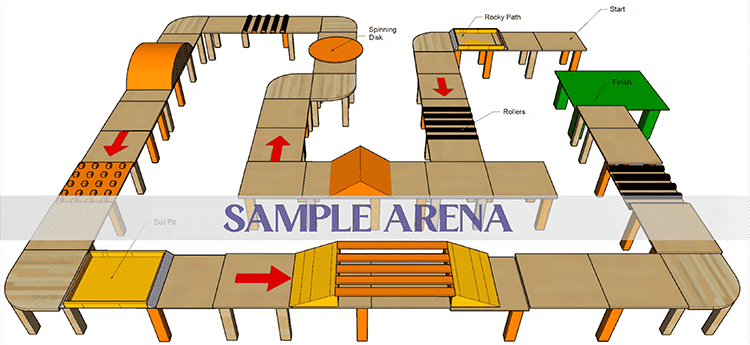
Racing Track
- The track for the Racer Bot will be 500 sq ft.
- A lot of obstacles will be present on the track for the Racer Bot to overcome.
- Multiple check points will be given on the track.
- A sample arena is shown below.
Gameplay and Rules
- Before entering the arena the bot will be placed inside a rectangular box (30cm long, 30cm wide, and 40 cm in height) to check if it meets the desired specifications.
- Two teams will participate and run the Racer Robo track simultaneously. If there are an odd number of teams, one may run on the track alone as well because the arena does not overlap. The bots will not be competing against each other but will race to finish with the fastest time in the qualifiers. During the knockout rounds teams will go head-to-head to overcome obstacles and race to the finish line.
- The competition consists of 5 stages:
- Stage 1: Qualifying Rounds
- 1. One or Two teams will run on the track simultaneously to record their fastest time completion.
- 2. One team member will control the robot and is the only person allowed in the arena.
- 1. The team must complete the track without competing for time.
- 2. The judge will whistle at the start and finish of the race.
- 3. You have a maximum of 5 minutes to complete the track.
- 4. You can repair your bot in this duration.
- i.No robot changes will be allowed after Round 1.
- ii.No extra practice or repairs after Round 1.
- iii.One extra minutewill be given to make any repairs before the timed round begins.
- 1. The robots' time to complete the course is recorded.A maximum of 5 minutes will be given to complete the track. The race will end after 5 minutes and the position of each bot on the track will be noted.
- Toppling or Malfunction:
- i. If the robot topples or wires come out, the team member must reset the robot to the marked box after the crossed check point.
- ii.The robot can only be reset 3 times. After 3 resets, a 5-second penalty is applied for each additional reset.
- 3. Final Time Calculation: The final time = Round 2 time + Penalty time.
- 1. The top 6 teams with the least final time will proceed to Stage 2.
* Each team must complete the race within a maximum of 5 minutes. If the time limit is exceeded, the race will be stopped, and the team’s progress will be recorded based on the fastest time (including penalties) to the furthest checkpoint reached.
Stage 2: Grand Finale Qualifiers*- 1. There will be 18 races between the top 36 teams from each zonal round. Two teams will simultaneously run on the track to record their best time.
- 2. If the count of teams is odd in number, one team may run the track individually.
- 3. The top 16 with the fastest time will proceed to Stage 3.
- 3. In case the team count is less than 16, we will announce the top 8 directly.
Stage 3: Qualifiers*- 1. There will be 8 races between the top 16 teams selected in stage 2. Two teams will simultaneously run on the track to record their best time.
- 2. The top 8 with the fastest time across top 16 will proceed to Stage 4.
- 3. In case the team count is less than 8, we will announce the top 4 directly.
Stage 4: Semi-Finale*- 1. There will be 4 races between the top 8 teams selected in stage 3. Two teams will simultaneously run on the track to record their best time.
- 2. The top 4 will proceed to Stage 5.
Stage 5: Grand-Finale- 1. There will be 2 matches between the top 4 teams: T1 vs T2, T3 vs T4
- 2. The pairing of teams will be done using a chit system.
- 3. The two teams will race to compete against each other in a knockout round.
- 4. The losing teams from each race (L1 and L2) will compete once more to determine the third-place winner.
- 5. The winning teams (W1 and W2) will face off again to decide the first and second positions
- 1. After the final match, the competition concludes with the following titles:
- Winner
- 1st Runner-Up
- 2nd Runner-Up
Competition Information
Venue: Bengaluru (India)
Registration Fee:
- For Indian residents: INR 999/- (Inclusive GST) per team.
- For non-India residents: USD 50 per team.
Prize Bifurcation
Zonal Round:
Each competition will announce a 1st, 2nd and 3rd position winner. Each winning team will receive a certificate.
The top 6 teams will be invited to participate in the Grand Finale, scheduled in Bengaluru.
International Grand Finale
Each winning team will receive a certificate and trophy. A total cash prize worth ₹1.5 lacs will be disbursed among the winning teams.
| Winner | First Place | Second Place | Third Place |
|---|---|---|---|
| Developers | ₹ 30,000/- | ₹ 20,000/- | ₹ 10,000/- |
| Innovators | ₹ 35,000/- | ₹ 25,000/- | ₹ 15,000/- |
Disqualifications
A team will be disqualified if it takes any of the following actions during the game:
- The design and build of the robot are not as per the desired criteria.
- The team intentionally damages or tries to damage the field, facilities, or game objects.
- The team performs any acts that are not in the spirit of fairplay.
- The team fails to obey instructions or warnings issued by referees.
Safety
The design and build of robots should not pose any kind of danger to any person at the competition scene. All robots must be designed and built to cause no damage to any robots of the opposing team or the field. Given below are some safety measures to be followed:
- Team members must wear running shoes during the games and test runs.
- The use of explosives, fire, or dangerous chemicals is prohibited.
- Accumulators, and lead-acid batteries are not allowed.
- When using radio for signal transmission, teams must design systems, circuits, and mechanisms to ensure they do not go out of control and/or move dangerously even if a short circuit occurs or a connection is broken.
- Use wires, connectors, terminals, etc., with a rated current equal to or higher than the assumed maximum current.